Rent-a-Node™ is Revolutionizing Data Center Economics
The Rent-a-Node™ model transforms underutilized spaces into profitable decentralized data centers, effectively bringing cloud to the edge to deliver real time AI driven data insight.
Why it Matters?
The demand for data center resources from AI, data analytics, and cloud applications is growing exponentially.
Conventional approaches to new data center build-out or expansion will not satisfy demand because it’s time consuming, cost prohibitive, and may require new real estate acquisition. Additionally, legacy cloud server and storage architectures place a high demand on power and cooling resources.
There’s a better way to address these challenges: it’s called Rent-a-Node™ (RaN), and it’s fundamentally changing the economics of how customers leverage the public cloud.
Our solution enables service providers to easily meet the growing demands for data center resources with a decentralized cloud computing model, while also allowing cloud tenants to achieve operational flexibility and financial benefit.
How it Works?
These are some examples of customers who are ideal candidates for becoming a service provider or Rent-a-Node™ Operator:
Anyone with underutilized real estate assets, such as empty office, retail, industrial, government and agricultural spaces, can easily convert these assets into a predictable revenue stream by fulfilling the demand for data center resources.
Customers who would like to diversify revenue from their real estate assets. For example, an REIT (Real Estate Investment Trust) that owns a building with ten high-demand office spaces can lease out 80% of the offices to traditional businesses, while the remaining 20% can be used for Rent-a-Node™ deployment.
Existing cloud service providers and data centers who would like to quickly expand their services without the limitations associated with legacy server and storage architectures.
Government agencies who would like to revitalize communities and gain new revenue streams by converting available or abandoned real-estate assets into local data centers.
Enterprises that provide software and infrastructure as a service.
Operators purchase Symbiote® bare metal servers/racks from Cachengo®. They simply provide climate-controlled environments, reliable power, and internet connectivity. Cachengo® installs the system on-site and handles 100% of the set-up, ensuring that the nodes are available for rent.
These are some examples of customers who can benefit from becoming a Rent-a-Node™ Tenant:
SaaS companies who are looking to increase profitability can reduce their software hosting costs by 70%-90%, when compared to traditional service providers. Additionally, the absence of data egress charges ensures a more predictable OPEX spend.
Edge Cloud Storage Integration – Customers with edge applications requiring local storage, such as video surveillance/security applications, sensor data, and real-time analytics. Data can be stored for long-term retention on the Symbiotes or periodically synchronized with the central cloud for archival purposes, as needed by the enterprise.
Customers with edge deployments who want data management flexibility and choice with a decentralized cloud architecture, as compared to centralized data centers from conventional cloud service providers.
Organizations who would like to consume Symbiotes for internal use AND offer Symbiotes for use by their constituents, customers, and vendors. These can include government agencies and non-profit organizations.
The Operator purchases Symbiote® bare metal servers/racks from Cachengo®. They simply provide a climate-controlled environment, reliable power, and fast internet.
Cachengo® installs the system on-site and handles 100% of the set-up, ensuring that the Symbiote® bare metal servers are available for rent. It’s fundamentally a “hands-off” operation from the Operator’s perspective.
The Operator gains revenue by renting out individual Symbiote® bare metal servers to the Tenant.
The Tenant rents Symbiote® bare metal servers from the Operator and associated software from the software application provider.

The Benefits
Fulfill the demand for data center resources by becoming a Rent-a-Node™ Operator
Repurpose Real Estate: Operators can repurpose their existing real estate assets and secure a predictable revenue stream from Day 1 by fulfilling the demand for data center resources.
Dramatic Cost Reductions: Experience 99% less power and 97% less floor space consumption compared to traditional server and GPU architectures.
Deployment Flexibility: Small form factor, low-power AI computing clusters can be deployed ANYWHERE with unparalleled security, cost-efficiency, and simplicity.
Space and Energy Efficiency: The base Rent-a-NodeTM configuration offers 99% less power, 95% less floor space,and 97% less rack units compared to traditional servers.
Stable Yields: Data centers provide utility-like returns with risk-adjusted, stable yields.
Enhanced Security and Governance: The peer-to-peer network architecture significantly enhances security, making data breaches virtually impossible.
Cost Efficiency: Achieve significant reductions in CAPEX (by 5X) and OPEX (by 4X) compared to traditional server architectures, thanks to energy and rack-space efficient design.
Immediate Utilization: Achieve 100% occupancy from the first day.
Significant Revenue Potential: $107K per month expected net revenue.
Flexible Financing: Various financing options to suit your business needs.
Highly Modular: Rent-a-Node™ deployments allow Operators to start with a small deployment and scale up gradually.
Achieve operational flexibility and financial benefits by becoming a Rent-a-Node™ Tenant
Improve Profitability: SaaS companies can reduce software hosting costs by 70%-90% when compared to traditional service providers, resulting in increased profitability. Additionally, the absence of data egress charges ensures a more predictable OPEX spend.
Data Management Flexibility and Improved Performance: Decentralized cloud architecture results in managing and storing data closer to where it’s generated, resulting in enhanced performance and responsiveness.
Scale Seamlessly: Easily scale compute and storage to meet application and data growth.
The Requirements
Here is an overview of the requirements:
From the Rent-a-Node™ Operator
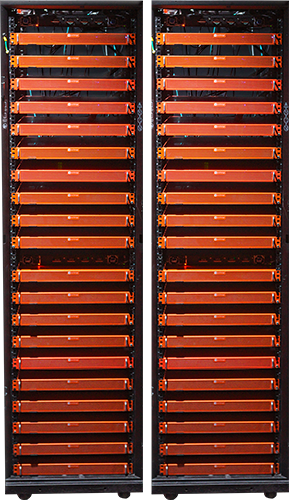
Space to support two racks. Each rack is 84” high, 24” wide, 30” deep and weighs ~665 lbs.
Ambient room temperature 78°F-80°F, and between 45% and 55% relative humidity
Minimum 2 Gb of fiber or other internet comparable service
Minimum 200-amp electrical service
$1.5M USD initial investment to Cachengo®
From Cachengo®
Two racks, each with 20 Pizza™ platforms for a total of 1,280 Symbiote®, with a power distribution unit, and core and top of rack networking.
Each Symbiote® contains 512GB of storage, for a total of 655TB for the base configuration.
Once the operator’s site is ready and meets installation guidelines, Cachengo® will complete the installation and set-up of the Rent-a-Node™ racks at the operator’s location.
Cachengo® will complete the set-up to ensure the Symbiote® nodes are available for rent.
Rent-a-Node™ FAQ
Rent-a-Node™ enables revolutionary new revenue streams for service providers (Operators) and significant savings for software-as-a-service (SaaS) companies on their hosting services (Tenants).
Operators purchase Symbiote® based Pizza™ 1U platforms from Cachengo®. Operators provide climate-controlled environments, reliable power, fast internet, and Cachengo® installs the system on location. It’s really that simple!
These Tenants also benefit by avoiding expenses associated with purchasing their own servers, GPUs, and storage infrastructure. By using Rent-a-Node™, they only pay for resources they use.
By using Knowhere™, an easy-to-use infrastructure management and marketplace portal, Operators can offer Symbiote® nodes for rent to Tenants.
For Tenants, renting Symbiote® based infrastructure nodes to host their software applications can result in a 70% – 90% reduction in hosting costs, compared to traditional cloud service providers.
Additionally, there’s zero data egress charges with Rent-a-Node™, further improving profitability for Tenant.
There is also a minimum requirement of 2Gb (2 gigabit per second), and non-redundant fiber internet connection.
Operators can offer Symbiote® nodes for rent to Tenants. Tenants can then rent Symbiote® nodes and select the software applications they need.
Additionally, Symbiote® nodes will only share data within a peer group, isolating data only to those that have access rights to the nodes.